Latvian Food Processing in 2026: Growth, Pressure and the Next Investment Cycle
Latvia’s food-processing industry entered 2026 in a stronger position than many other manufacturing sectors. Production is growing, dairy processing is expanding, export markets remain important and several producers are investing in new capacity.
However, the overall picture is not uniformly positive. Beverage production has weakened sharply, raw-material prices remain volatile and food manufacturers face continuing pressure from labour costs, energy use, packaging regulation and retail pricing.
The result is an industry that is still growing—but increasingly rewarding efficiency, flexibility and export capability rather than production volume alone.
One of Latvia’s principal manufacturing sectors
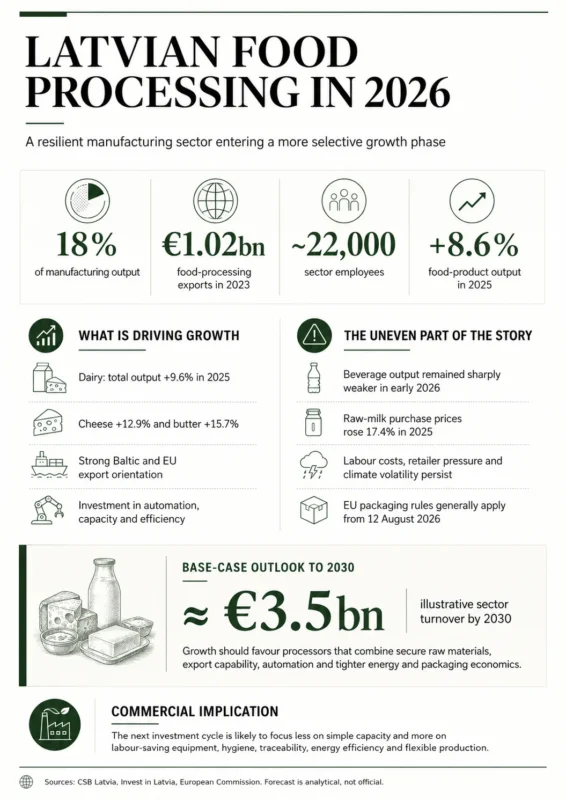
Food and beverage production is one of Latvia’s largest industrial activities. According to Invest in Latvia, it accounts for approximately 18% of the country’s total manufacturing output and employs around 22,000 people.
Food-processing exports reached €1.02 billion in 2023, representing 5.4% of Latvia’s total exports. Lithuania, Germany and Estonia are among the sector’s most important markets, while Latvian products are also sold in Scandinavia, North America and Asia.
More than half of Latvia’s processed fruit and vegetable, fish and grain-product output is exported. This reflects one of the defining characteristics of the local industry: Latvia’s domestic market is relatively small, so sustained growth usually requires access to neighbouring and international markets.
Food production is currently outperforming the wider industry
Latvian food manufacturers recorded substantial production growth during 2025. At constant prices, food-product manufacturing output increased by 8.6% compared with 2024.
The positive trend continued into 2026. During the first four months of the year, food-product output was 5.4% higher than in the corresponding period of 2025. In May 2026 alone, food production increased by 8.4% year on year.
This shows that the recent improvement cannot be explained only by higher selling prices. Production volumes have also risen.
The strongest results are nevertheless concentrated in particular product groups. Dairy and several export-oriented food categories are performing considerably better than beverages, where production remained more than 30% below the previous year during the first four months of 2026.
Latvia therefore does not have one single food-industry cycle. Different subsectors are moving in different directions.
Dairy is the clearest growth segment
Dairy processing is currently one of the strongest parts of the Latvian food industry.
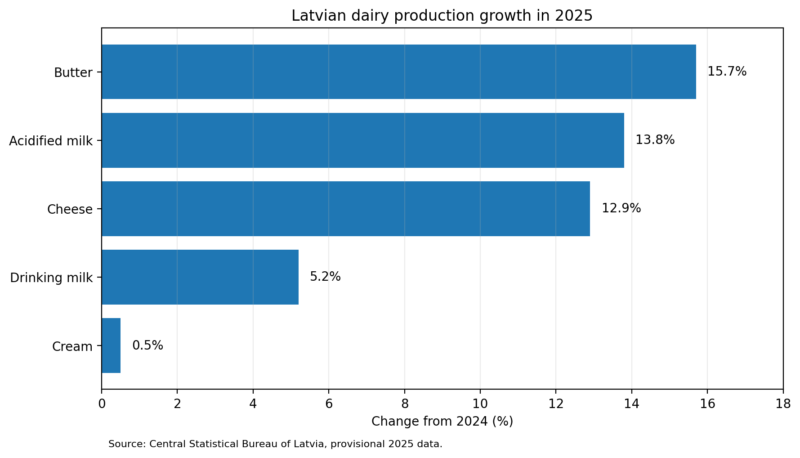
According to the Central Statistical Bureau, output of dairy products intended for sale increased by 9.6% in 2025. Production increased across every principal dairy category:
* butter production increased by 15.7%;
* acidified milk products increased by 13.8%;
* cheese production increased by 12.9%;
* drinking milk increased by 5.2%;
* cream production increased by 0.5%.
Latvian processors collected 839,500 tonnes of raw milk during the year, slightly more than in 2024.
These figures support a positive outlook for cheese, fermented milk products, specialised dairy ingredients and other products with export potential.
Growth has come with a significant cost increase, however. The average raw-milk purchase price reached €477.03 per tonne in 2025—17.4% higher than one year earlier.
For processors, increasing output does not automatically mean improving profitability. Production efficiency, yield, energy consumption, product mix and the ability to pass costs through the supply chain remain decisive.
Exports remain the principal route to scale
Latvian food producers benefit from close access to Lithuania, Estonia, Germany and the Nordic markets. The neighbouring Baltic countries effectively function as an extended home market for many manufacturers.
But competition in these markets is becoming more demanding. Latvian producers must compete not only on price, but also on:
* product consistency;
* food safety and traceability;
* packaging quality;
* delivery reliability;
* private-label capability;
* production flexibility;
* certification and sustainability performance.
Niche markets are also becoming relevant. Latvian food exports to Japan, for example, reached €6.8 million in 2024. Although this is small compared with trade inside the European Union, it shows the potential for premium dairy products, confectionery, berries, grain products and other distinctive Latvian foods.
For most medium-sized processors, participation in international exhibitions, cooperation with distributors and the ability to adapt products and packaging to individual markets will remain essential.
Investment is moving from capacity to efficiency
The next phase of industrial investment will probably differ from the previous one.
When labour, raw materials and energy were less expensive, manufacturers could increase output partly by adding personnel or operating existing lines for longer periods. That model is becoming less attractive.
Companies are now more likely to invest in equipment that improves output per employee and reduces production losses. Priority areas include:
* automated product handling and packaging;
* portioning and dosing accuracy;
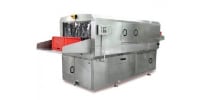
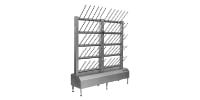
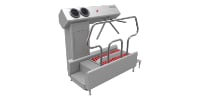
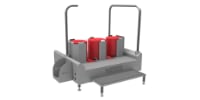
* labour-saving washing and hygiene systems;
* digital production monitoring;
* traceability and quality-control systems;
* heat recovery and lower energy consumption;
* water and chemical-use optimisation;
* flexible machinery capable of producing several product formats.
These investments are not relevant only for the largest manufacturers. Smaller processors often face an even stronger need to automate because they have fewer employees, more product changes and shorter production runs.
The objective is no longer simply to produce more. It is to produce more consistently, with fewer interruptions, less waste and lower unit costs.
Packaging regulation becomes an operational issue in 2026
Food manufacturers must also prepare for changes under the European Union’s Packaging and Packaging Waste Regulation.
The regulation entered into force in February 2025 and generally applies from 12 August 2026. It introduces requirements affecting packaging design, recyclability, material composition, reuse and packaging-waste prevention.
For food producers, this may require cooperation between production, purchasing, quality, marketing and machinery suppliers. A packaging change is rarely just a graphic-design change. Different materials can affect:
* sealing performance;
* shelf life;
* machine settings;
* forming temperatures;
* line speed;
* product protection;
* labelling;
* storage and transport.
Processors planning new packaging equipment should therefore consider future material requirements and format flexibility rather than designing a line around only one current package.
The principal risks remain manageable—but significant
The outlook for the Latvian food industry is positive, although several risks could slow development.
Raw-material volatility
Milk, meat, fish, grain, berries and other agricultural inputs remain exposed to weather, international prices and regional supply conditions.
Labour availability and wage pressure
Food manufacturing still requires significant manual labour, particularly in handling, preparation, cleaning, packing and quality control. Wage growth increases the return on well-targeted automation.
Retailer and consumer price pressure
Processors may face rising costs while retailers and consumers resist further price increases. This can compress margins even when turnover grows.
Uneven subsector performance
The weakness in beverages during early 2026 demonstrates that growth in one category cannot be assumed across the entire industry.
Regulation and compliance
Packaging, sustainability, labelling and food-safety requirements are increasing. Larger manufacturers may have dedicated compliance teams, while smaller companies must manage the same changes with more limited resources.
Forecast to 2030
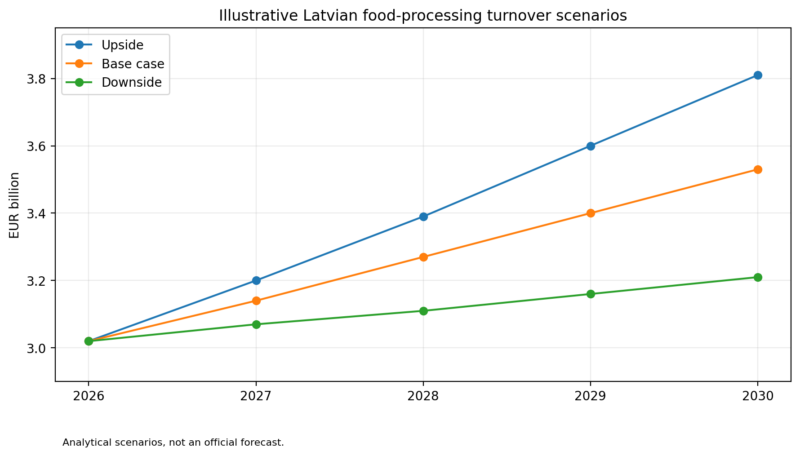
The most probable scenario is continued moderate growth rather than another inflation-driven surge in nominal turnover.
Based on the comparable historical industry data and the production trends recorded in 2025 and early 2026, an analytical base case would place Latvian food-processing turnover at approximately €3.5 billion by 2030.
This is not an official forecast. It assumes:
* continuing strength in dairy and grain-based products;
* stable access to Baltic and European export markets;
* gradual investment in automation and energy efficiency;
* modest domestic consumption growth;
* no major raw-material or geopolitical shock.
An upside scenario could take turnover closer to €3.8 billion by 2030 if export diversification, premium products and new production capacity develop faster.
A weaker scenario of approximately €3.2 billion could result from prolonged input-cost pressure, poor agricultural seasons, weak consumer demand or delayed industrial investment.
Employment is unlikely to grow at the same rate as turnover. The more likely pattern is stable or slightly declining employment combined with higher production per employee.
What this means for Latvian food producers
The industry’s direction is relatively clear.
Latvia will continue to have competitive advantages in dairy products, grain processing, fish, confectionery, berries and selected premium or traditional foods. But market success will increasingly depend on industrial capabilities behind the product.
The companies in the strongest position will be those that can:
1. secure reliable raw-material supplies;
2. maintain consistent product quality;
3. manufacture efficiently in relatively small batches;
4. adapt packaging and products to different markets;
5. reduce labour, energy, water and waste costs;
6. meet changing European regulatory requirements;
7. develop stable export partnerships.
Latvian food processing is therefore not merely recovering from the disruptions of recent years. It is entering a new investment cycle.
That cycle will be defined less by basic production expansion and more by automation, hygiene, traceability, resource efficiency and flexible production technology.
For equipment suppliers, processors and their business partners, this creates a clear opportunity: helping Latvian manufacturers produce safer, more efficiently and with greater flexibility for both local and export markets.
Data sources include the Central Statistical Bureau of Latvia, Invest in Latvia, the European Commission and Latvian food-industry business reports. The 2026 and 2030 turnover figures presented in the forecast section are analytical estimates rather than official forecasts