Smart packaging does not have to mean a new package
In a 2026 Chemical Engineering Journal study, Fanze Meng and colleagues did not replace the tray, film or primary packaging material with an experimental hydrogel. They placed a 23 mm hydrogel disc in the headspace of a sealed container holding 25 ± 1 g of pork, without direct contact between the sensor and the meat.
For the meat industry, that may be one of the most interesting details in the paper.
The study does not demonstrate a commercial insert, patch or label. It does, however, suggest a development route that leaves the main package largely alone. That matters in an industry where an innovation becomes considerably less attractive once it requires replacing equipment that already works.
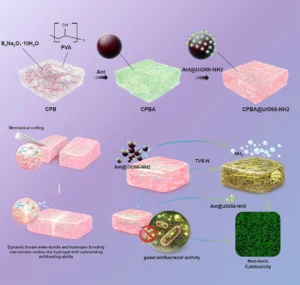
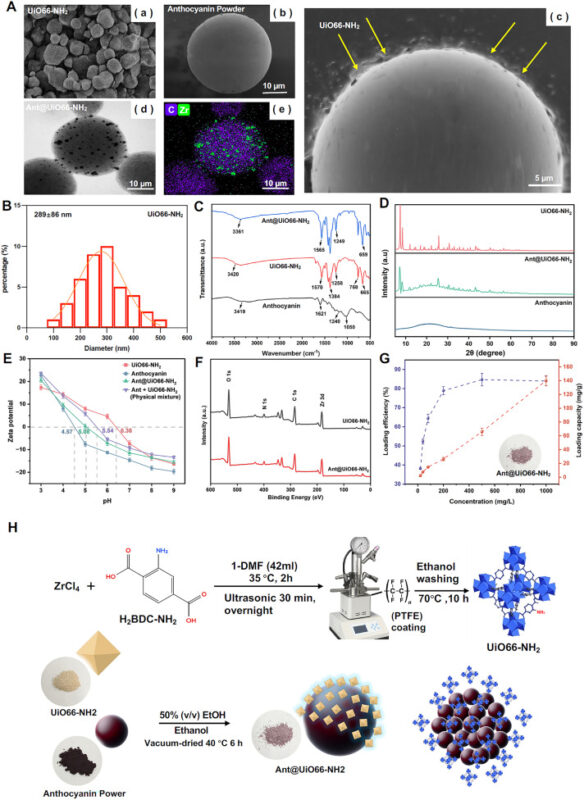
The material itself is more adventurous. Researchers incorporated purple-sweet-potato anthocyanins immobilised on UiO66-NH₂, a zirconium-based metal-organic framework, into a cellulose nanofiber/PVA/borax hydrogel. The anthocyanins provide the colour response; the MOF helps stabilise them; the hydrogel provides the supporting structure.
The important step is not simply making something change colour.
Free anthocyanins are sensitive to environmental degradation, which limits their usefulness in intelligent packaging. In this study, immobilising them on UiO66-NH₂ improved their stability while preserving their pH- and ammonia-responsive behaviour.
That addresses a more serious problem than producing an impressive laboratory demonstration. A freshness indicator is of little practical use if the material responsible for the signal degrades, migrates or becomes unreliable before the food does.
The researchers also asked whether the colour response tracked anything meaningful in the meat.
For the CPBA@U200 formulation, the colour-difference value, ΔE, showed strong relationships with pork pH, total volatile basic nitrogen and total viable count. The reported R2 values were 0.933 for pH, 0.956 for TVB-N and 0.902 for total viable count.
That distinction is important. A label that changes colour is a demonstration. A colour signal that follows chemical and microbiological measures of deterioration begins to look like a sensing system.
Begins to.
The test was conducted at 20°C for up to 96 hours in sealed Petri dishes. It does not establish performance through a commercial chilled chain, under modified atmosphere, during transport or after extended storage before use. The authors themselves identify long-term stability under practical storage and transport conditions as work still to be done.
That gap should not be hidden behind the usual “promising technology” language. It is the next engineering question.
The formulation results add another useful complication. There was no single version of the material that was simply best at everything.
CPBA@U100 produced the strongest reported self-healing performance, recovering 72.61% of its tensile strength after five minutes, 94.33% after 30 minutes and 98.98% after 120 minutes. CPBA@U200, meanwhile, produced the strongest reported relationships between colour change and spoilage indicators and was also used to demonstrate a preservation effect. Under the study conditions, it delayed increases in pH, TVB-N and total viable count and extended measured shelf life by approximately 12 hours relative to the control.
More active material, in other words, is not automatically better in every respect.
That is probably good news for product development. The eventual question is unlikely to be how many functions can be packed into one hydrogel. It is which function the commercial component actually needs to perform.
A freshness indicator may need maximum colour separation. A mechanically demanding component may favour another formulation. A preservation function may pull the design in a different direction again. The paper presents a multifunctional material, but its own results argue against treating “multifunctional” as a specification.
The colour data make the same point from another angle. CPBA and CPBA@U10 showed overlapping RGB signals during later stages of storage, while CPBA@U100 and CPBA@U200 maintained clearer separation. The researchers propose smartphone-based RGB quantification as future work.
The smartphone system has not yet been demonstrated, and it should not be presented as if it has. Still, the underlying issue is already visible: a freshness indicator is only useful if different product states can be distinguished reliably.
The 12-hour preservation result also needs similar discipline. It applies to this controlled experiment at 20°C. It is not evidence that a commercial pork pack will gain another half-day of shelf life.
What the study has reached is a more interesting stage than either a finished-product story or a piece of laboratory theatre. The sensing chemistry has been stabilised, the colour response has been compared with recognised indicators of pork deterioration, and different formulations have produced meaningfully different performance profiles.
The next test is less glamorous but more relevant to industry: can the same signal survive chilled storage, real package atmospheres, transport and normal handling?
For now, the least disruptive clue may be the 23 mm disc itself. The researchers tested the sensor as something placed inside the package, not as the package.
For a conservative industry, that distinction is not trivial.
Research source
Meng, F. et al. (2026). “Self-healing cellulose-based hydrogel smart packaging embedded with anthocyanin-immobilized metal–organic frameworks for food preservation and freshness monitoring.” Chemical Engineering Journal, 538, 176764. DOI: 10.1016/j.cej.2026.176764